If you’re exploring implants vs bridges Sydney, you’re not alone. Many adults, especially those in their 40s, 50s and beyond, face the challenge of replacing one or more missing teeth. Whether tooth loss is due to decay, gum disease, injury or ageing, choosing the right solution is essential for your comfort, confidence, and long-term oral health.
At USmile Dental Club, your trusted dental clinic Box Hill, we help patients every day weigh the pros and cons of dental implants and bridges. Both options can restore function and aesthetics, but which one is truly best for you?
In this comprehensive guide, we’ll compare treatment processes, costs, longevity, comfort, and long-term oral health benefits to help you make a confident decision.
Understanding the Basics: What are Dental Implants and Bridges?
Dental Implants
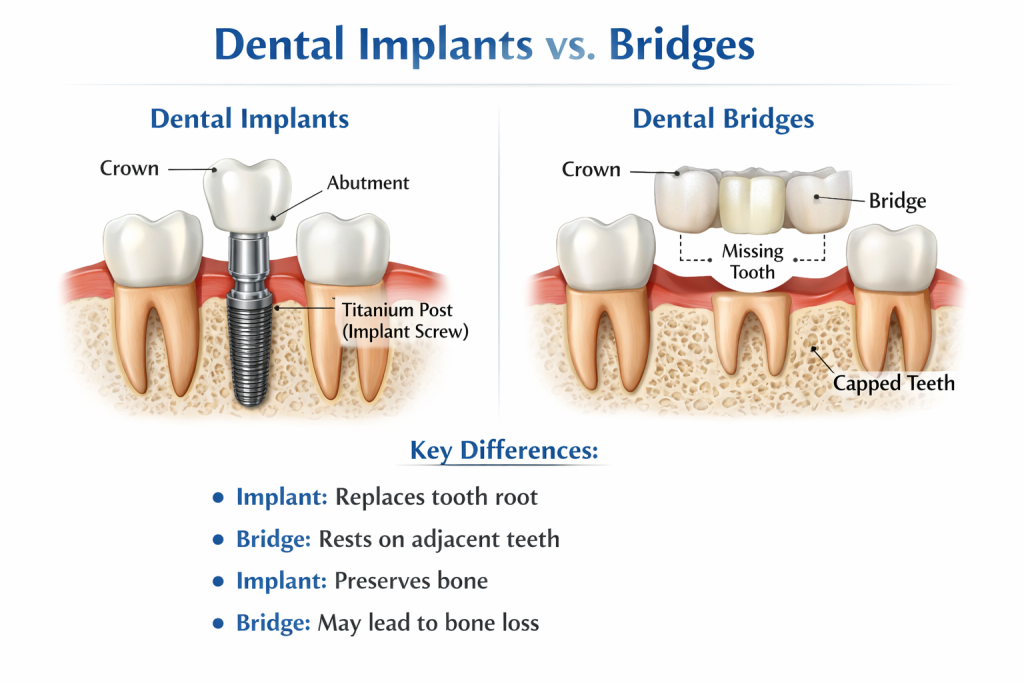
A dental implant is a titanium post surgically placed into your jawbone to replace a missing tooth root. Once healed, it supports a custom crown that looks and functions like a natural tooth.
An implant consists of:
- The implant post (artificial root)
- The abutment (connector)
- The crown (visible tooth)
Implants are often recommended for patients seeking a long-lasting and natural-feeling solution.
Dental Bridges
A dental bridge fills the gap left by a missing tooth by anchoring an artificial tooth to the natural teeth on either side. These adjacent teeth are reshaped and fitted with crowns to support the bridge.
Bridges are a faster solution compared to implants and may suit certain patients better depending on their oral health condition.
If you’re considering crown & bridge Box Hill, our experienced clinicians can guide you through personalised options.
Implants vs Bridges Sydney: A Side-by-Side Comparison
Let’s break down the most important factors.
1. Procedure and Treatment Timeline
Implant Procedure Steps
The implant procedure steps typically include:
- Comprehensive assessment (X-rays/3D scans)
- Implant placement surgery
- Healing period (3–6 months for osseointegration)
- Abutment placement
- Crown placement
Implants require patience, but they offer a permanent solution.
Bridge Procedure
A dental bridge generally requires:
- Tooth preparation (reshaping adjacent teeth)
- Impressions
- Temporary bridge placement
- Permanent bridge fitting (usually within 1–2 weeks)
Verdict:
If you need a quicker solution, bridges may seem appealing. If you prefer a long-term investment, implants win.
2. Longevity and Durability
- Dental Implants: 15–25+ years (often lifetime with proper care)
- Dental Bridges: 7–15 years on average
Implants integrate with the jawbone, preventing bone loss and maintaining facial structure. Bridges do not prevent bone shrinkage beneath the missing tooth area.
For adults concerned about long-term oral health, implants provide a clear advantage.
3. Impact on Adjacent Teeth
This is a critical difference in the bridge vs implant pros cons discussion.
- Implants: Do NOT affect neighbouring teeth.
- Bridges: Require reshaping healthy adjacent teeth.
For older patients wanting to preserve remaining natural teeth, implants are often the more conservative choice.
4. Aesthetic Results
Both solutions look natural when crafted by skilled professionals. However:
- Implants mimic natural tooth roots, offering superior gum contour support.
- Bridges may show slight gum changes over time due to bone shrinkage.
At USmile Dental Club, we focus on seamless smile restoration tailored to your facial aesthetics.
5. Comfort and Function
Dental implants:
- Feel like natural teeth
- Allow strong bite force
- Do not shift or move
Bridges:
- Restore chewing ability
- May feel slightly different due to connection with adjacent teeth
Patients often report implants feel more “natural” in daily life.
Dental Implant Cost Box Hill vs Bridge Costs
Cost is often a deciding factor.
Dental Implant Cost Box Hill
Implants typically cost more upfront because they involve:
- Surgical placement
- High-quality titanium materials
- Custom crown fabrication
- Advanced imaging
However, they often last much longer, making them cost-effective over time.
Bridge Costs
Bridges generally have a lower initial cost but may require replacement sooner, especially if supporting teeth weaken.
When evaluating implants vs bridges Sydney, it’s important to consider lifetime value, not just upfront pricing.
We offer consultations to provide transparent breakdowns of your personalised treatment plan.
Bone Health and Facial Structure
One of the most overlooked aspects of tooth replacement is jawbone preservation.
When a tooth is lost:
- The jawbone begins to shrink.
- Facial sagging may occur over time.
Dental implants stimulate the bone like natural roots, preserving bone density and supporting youthful facial structure.
Bridges do not offer this benefit.
For adults concerned about aging appearance and long-term oral health, implants provide significant advantages.
Bridge vs Implant Pros Cons: Quick Summary
| Factor | Dental Implant | Dental Bridge |
| Surgery Required | Yes | No |
| Treatment Time | Longer | Shorter |
| Longevity | 15–25+ years | 7–15 years |
| Bone Preservation | Yes | No |
| Affects Adjacent Teeth | No | Yes |
| Upfront Cost | Higher | Lower |
Dental Implants vs Bridges: Candidate Comparison Guide
| Criteria | Good Candidate for Dental Implants | May Prefer a Dental Bridge |
| Gum Health | Have healthy gums | May still qualify even with minor gum concerns (subject to assessment) |
| Jawbone Condition | Have sufficient jawbone to support an implant | Limited bone volume or prefer to avoid bone grafting |
| Smoking Habits | Do not smoke heavily | Heavy smoking may reduce implant success rate |
| Treatment Preference | Want a permanent, long-term solution | Prefer a faster treatment timeline |
| Surgical Suitability | Comfortable undergoing minor oral surgery | Not suitable for surgery or prefer a non-surgical option |
| Budget Consideration | Willing to invest in a long-term solution | Budget is a key concern (lower upfront cost) |
| Adjacent Teeth Condition | Adjacent teeth are healthy and do not require crowns | Adjacent teeth already need crowns, making a bridge practical |
| Bone Loss | Bone grafting may be recommended if bone loss has occurred | Prefer to avoid additional procedures like bone grafting |
Myths About Dental Implants
There are many misconceptions surrounding dental implants, particularly among older adults considering tooth replacement options. Some believe that implants are extremely painful, that they are too old to undergo the procedure, that implants will look artificial, or that healing takes an unreasonably long time. In reality, modern dental techniques and advanced anaesthesia significantly minimise discomfort during and after the procedure.
Age alone is not a disqualifying factor, as many patients in their 60s, 70s, and beyond successfully receive implants with excellent outcomes. Today’s implants are carefully designed to look and function just like natural teeth, blending seamlessly with your smile. With proper care and professional guidance, healing is predictable and well-managed, making dental implants a safe and reliable long-term solution for missing teeth.
👉 Concerned about Myths about Dental Implants? Speak with our team at USmile Dental Club today for clarity and expert advice.
Restoring Smile with Dental Implant
Missing teeth can impact far more than just your ability to chew, they can affect your confidence, speech clarity, and overall social comfort. Gaps in your smile may cause you to avoid certain foods, feel self-conscious when speaking, or hesitate to smile in social situations. Dental implants help restore natural chewing ability, improve speech clarity, support facial structure by preventing bone loss, and rebuild self-confidence. Many of our patients describe their implant journey as truly life-changing, allowing them to eat, speak, and smile freely again.
👉 Interested in restoring Smile with Dental Implant? Discover how our advanced implant solutions can transform your confidence at USmile Dental Club.
What about Crown & Bridge Box Hill Options?
If your surrounding teeth already require crowns, a bridge may be a practical combined solution.
Our crown & bridge Box Hill services include:
- High-quality ceramic materials
- Digital impressions
- Custom shade matching
- Precision fitting
We ensure every restoration blends naturally with your smile.
Long-Term Oral Health Considerations
When comparing implants vs bridges Sydney, think beyond the next few years.
Implants:
- Prevent bone loss
- Maintain alignment
- Support facial structure
- Protect neighbouring teeth
Bridges:
- Restore aesthetics quickly
- Require ongoing monitoring
- May need replacement over time
For patients prioritising long-term oral health, implants generally offer superior benefits.
Why Choose USmile Dental Club?
As a leading dental clinic Box Hill, we provide advanced 3D diagnostics, experienced implant clinicians, personalized treatment planning, transparent pricing discussions, and gentle, patient-focused care. Our approach is centred around understanding your individual needs and long-term goals, ensuring you feel informed and comfortable at every stage of treatment. Our goal is not just to replace missing teeth, but to restore your confidence, protect your long-term oral health, and help you enjoy a strong, natural-looking smile for years to come.
Final Thoughts: Which One Is Best?
There is no one-size-fits-all answer when choosing between dental implants and bridges. Dental implants may be the ideal option if you’re looking for a long-term investment, prioritise bone preservation, and want to protect neighbouring teeth from unnecessary alteration.
On the other hand, bridges may be more suitable if you prefer a faster treatment timeline, are seeking lower upfront costs, or already require crowns on adjacent teeth. Ultimately, the best decision comes from a professional evaluation tailored to your specific oral health needs, lifestyle, and long-term goals.
Ready to take the next step?
👉 Book Appointment with USmile Dental Club today and let our expert team help you choose the best solution for your smile.
Your journey to confident, comfortable living starts here.
FAQs
1. Are dental implants painful?
Implant procedures are performed under local anaesthetic. Most patients report mild discomfort that subsides within a few days.
2. How long do dental bridges last?
Bridges typically last 7–15 years depending on oral hygiene and regular dental visits.
3. What does the dental implant cost at Box Hill?
Costs vary depending on individual cases. A consultation is required for accurate pricing tailored to your needs.
4. Am I too old for dental implants?
Age alone does not disqualify you. Many patients in their 60s and 70s successfully receive implants.
5. Which option is better for long-term oral health?
Dental implants generally provide superior long-term oral health benefits due to bone preservation and tooth independence.